

Image-Object
CrossLypka at Bureau
May 23, 2026 | by Ian Myers
I
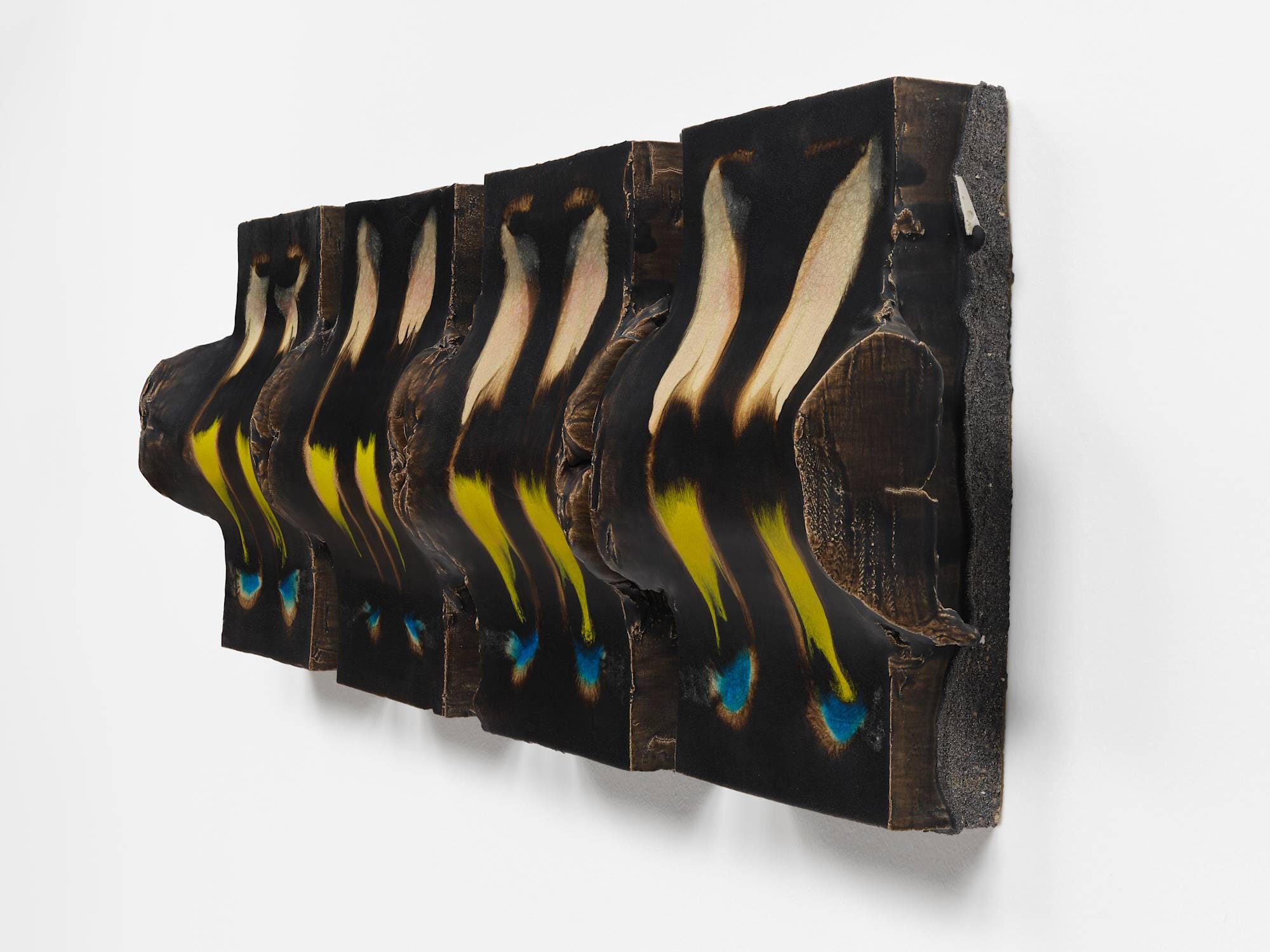
In Sports, the exhibition at Bureau by Oakland-based duo CrossLypka, the first work to the right when you walk in is made up of four, nearly identical, nearly symmetrical vertical ceramic panels aligned horizontally. It is titled bbbb, so maybe each is just a letter, but I don’t actually think that matters so much. These panels are closest together at the two stumpy forms that run horizontally through their center; each seeming like the approximate size and shape of the tube of clay emitted directly from a small pugmill, then blended into the more rigid panel. Each glaze-image, if we can call it that, is made up of six areas of colored glaze on a black ground: starting from the top, beige, lime green, and a smaller portion of blue. The effect of the glaze running down the surface creates a kind of cross shape in the center, as if that is its subject, but I don’t think that matters much either.
The looseness of any form here, along with each panel’s near-symmetry, allows them to be read as a kind of Rorschach test. It could be a kind of hook, leading a viewer by the nose to recognize this poster-child for a limited subjectivity, as if it is an antidote to the way we are taught to interact with images. After all, we are inundated with images every second of every day, and each successive image teaches us to be even more brief with the next, while we understand that a Rorschach test is, at the very least, different from that. But material choices deepen what would otherwise be a kind of visual pun about looking. Since each glaze-image is painted or poured, they’re more like Rauschenberg’s matching abstractions, close to sameness but never actually the same, at once doing away with and reinforcing the painterly sentiment of a kind of uniqueness in abstraction. Either way, variation of the hand or the unexpected occurring in the firing also seems to live behind a veil of crackle. This is especially noticeable in bbbb, where four panels are coated in a raku-like, fractured glaze; allowing that, in effect, any image that might have been recedes from us behind a screen of itself, a forever unreachable thing.
This contrasts starkly with the fact that each of these four panels do nothing to obfuscate their materiality; they look heavy, not unlike the oil paintings done towards the end of the Renaissance and into the beginning of the Baroque on stone, like Titian’s Ecce Homo dragged over the mountains. And these objects do have a relationship with painting, even if only to combat it. Each panel in bbbb and indeed many of the other works in the room seem to challenge the obvious limitations of a flat plane—draping it, folding it, compressing it with a two-by-four—and this confrontation carries much of the work of the glaze-image. By this I mean that the otherwise flat plane of bbbb is interrupted by how it drapes on the pugmill forms running through their center, and by the torn edge separating each panel. The lump of the pugmill form creates a topography that lets the glaze run away from this equator, and lends itself to some kind of expansion or frozen mitosis.
The rigid, foundational panels of bbbb encourage this comparison with painting. But again material interferes. The edges are coated about halfway down by the gritty silica sand or alumina or whatever else was used to keep the glaze from adhering to kiln shelves. A firing cone, used to gauge the temperature of the kiln, has adhered itself to the upper right edge of the rightmost panel, stark white against the black glaze.
This being the case, it’s fair to ask why bother comparing these to painting at all? On the one hand, it is certainly my own biases about why clay can be so compelling; it is as if it is a kind of non-Neutonian fluid, at least for a time, or rather a fat, gritty, beige paint that is, in a way, its own support. On the other hand is the nature of working in ceramics; namely, the distinct stages involved in its facture.
There is a kind of distancing that happens when a clay form is left to dry. It shrinks a little as it loses its water content and becomes brittle. It is distanced further after the first firing, where it’s transformed into ceramic and shrinks again. And then glazing, which only yields so many clues about its future before firing once more, often at an even higher temperature, where chemical reactions create new colors and the run and drip of liquid glass make new forms; images dictated by heat as much as the hand. The painters I admire most often describe painting as a relationship between the painter, the act of painting, and, at least in the case of Guston, this “other third thing;” the unexpected amalgamation of disparate elements of a work, coming together to make a thing greater than the sum of its parts. It’s a romantic notion, and maybe for some, a tired one. But really it stands as a kind of justification for having made the thing at all: that something happened, and happened in a way which could not have been fully accounted for by a plan alone. It stands as a justification that this thing is more than an image— it is a site, whether for discovery, revelation, or, in the case of the duo CrossLypka, reciprocity.
CrossLypka is composed of Tyler Cross and Kyle Lypka. The press release (one of the best I’ve read recently, by Theodora Walsh) describes the process: “each work is transformed by the artists’ respective touch.” And so this complicated relationship between maker and object is complicated further; Guston’s vague triad made real. I was reluctant, at first, to speculate about the logistical complications of this working arrangement. But how much richer these objects are for it. It’s a kind of call and response, between partner, kiln, and back again, enlivened by the unexpected, like a game of telephone, wherein all participants, whether person, object, or oven, can act in bad-faith, imbue new meaning, add and take away, and make anew. “I guess the question we are asking,” states Lypka in the press release, “is if it’s possible to share intuition with another person. And the answer is sort of, but never completely.”
II
I’ve been struggling to write about this show. These things are hard to write about. The objects, I mean. Every time I’ve started, I found myself building with one hand while unraveling with the other. So to begin the unraveling: it doesn’t matter whether anyone would look at these things as paintings. These image-objects, as I’ve come to think of them, offer more than enough to look at, think about, and scrutinize than could be gained by being tethered directly to such a narrow lineage. And each object in Sports is worthy of the scrutiny imparted to bbbb, and certainly more than I am able to offer here.
I am a painter; that is how I think of myself. However, I increasingly feel we are doing a disservice to the things we call paintings by calling them so, if only because to name the thing is to have that thing exist as a kind of shorthand. Given the way we are inundated with images, everything often feels reduced to a similar shorthand; made in such a way to be immediately digestible, understood and discarded. And maybe my pessimism about the moniker of painting is such because that’s just how I am. But maybe it’s so because it seems that, if one were to survey the painting exhibitions across New York over the past few months or even several years, it seems there is a Sisyphean impulse to compete with the over-saturation of images and embrace the shorthand of painting: another exhibition of paintings of or about photography; another hastily produced series of thin, impulsive abstractions, made market-ready, and seamlessly palatable.
It’s the shorthand for painting that makes this possible: there is canvas and there is paint, therefore this is a painting. Duchamp was right; in the modern era, the ubiquity of the tube of paint rendered it a readymade in its own right, and thereby paintings, as much as any stool impaled with a bicycle fork and wheel, are readymade as well. But that isn’t to say that all paintings are this way, or that whether or not the paint came from a tube matters at all. Instead, it is the consideration of material specificity, with all of its baggage and heft, like the way one pigment reflects and another absorbs the light around it—the kind of thing that can only ever be appreciated when standing in front of it—that matters.
My point is not to ring another death-knell for painting. On the contrary, the history of painting is as rich an avenue for making meaning as any other. Rather, it’s to say that material nuance, in painting especially, is a dying light, and it seems it is only in rare instances, like CrossLypka’s Sports, that it can be revived just enough to instill the faith to keep looking, and looking closely. It’s to say that the image is an object first, even if you only ever see it on your phone.
CrossLypka, Sports, Bureau, April 25 - May 30, 2026
About the Author:
Ian Myers is a painter and teacher based in Brooklyn. He received his BFA from the Cooper Union School of Art and MFA from Hunter College.