

Raphael: Sublime Poetry
The Metropolitan Museum of Art
May 10, 2026 | by Brock Riggins
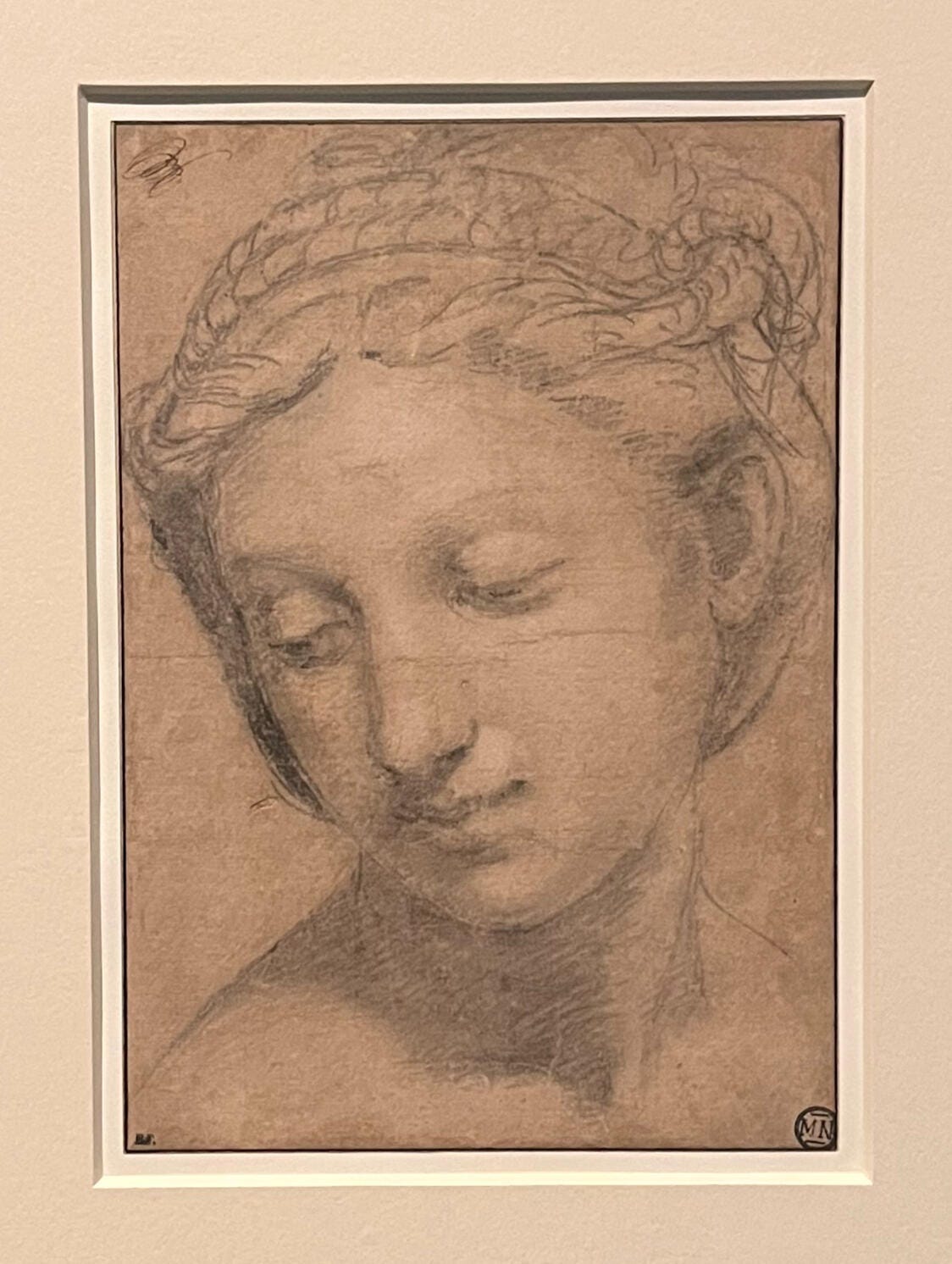
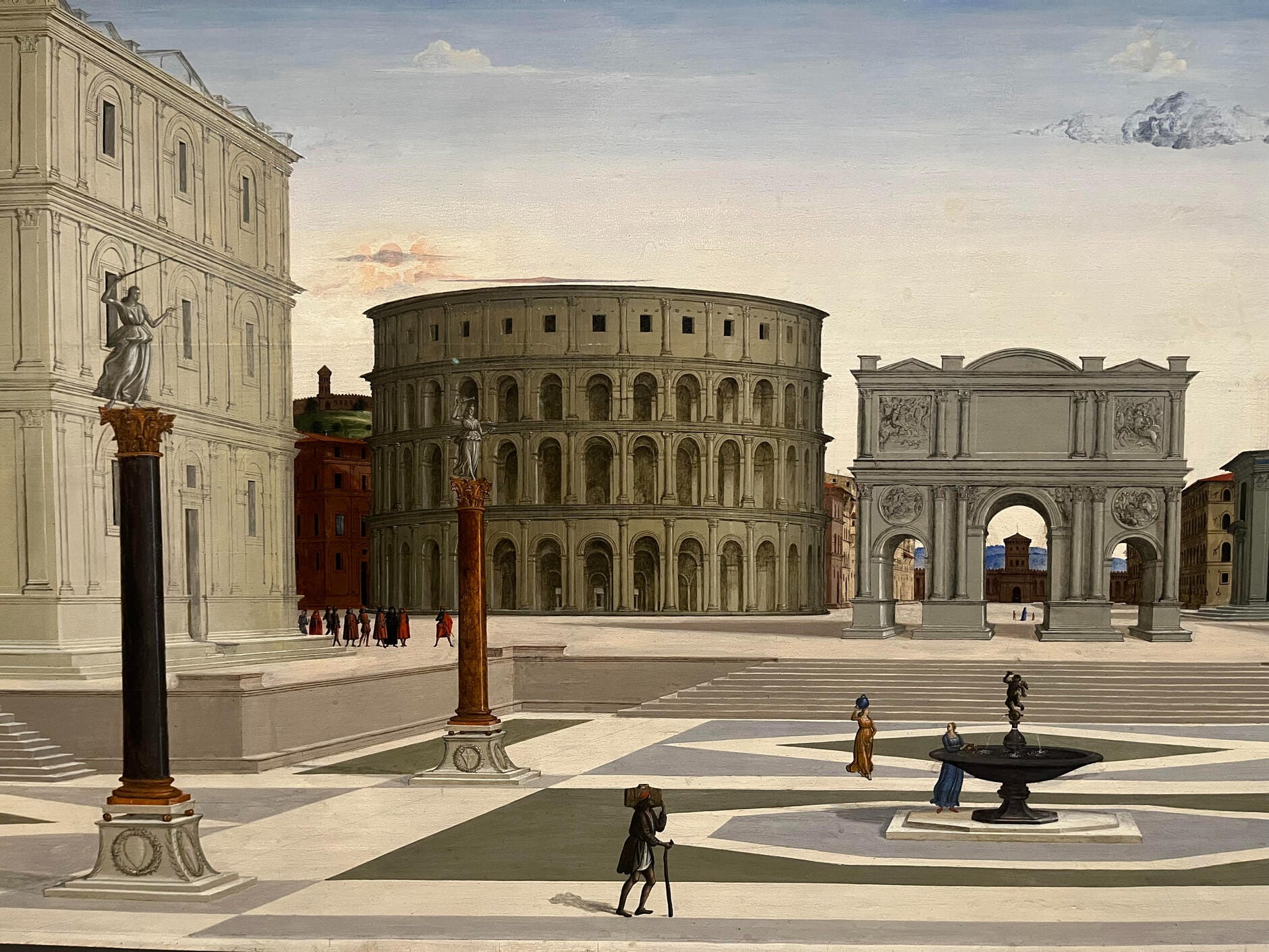
When we look at Raphael, where are we? Italy, maybe, but the background more often resembles the surface of Saturn’s furthest moon.After a touching self-portrait, the show offers an answer. In Fra Carnevale’s The Ideal City, a few unfortunates are trapped inside a vortex of flat churches and wide squares; you hear echoes of sharp shoes. The painting is an early attempt to work out linear perspective, that era’s big new idea. It’s rough—statues writhe in pain—but it balances well against surroundings of expected, somewhat bland embellishments of Christian gold leaf. I see why artists were bored. And when artists are bored, they play. I like play. I like painterly scaffolding. These aren’t in the show, but I like that Botticelli where Saint Zenobius teleports around a computer game. I like Piero flagellating Christ on a microchip. I like Masaccio putting the crucifixion at the end of a hallway. I like Raphael marrying the Virgin into a civic engineer’s fever dream. At different points in space-time, when Van Eyck and Leonardo take us further than Saturn’s moons, the amateur is intimidated by cloaks of perfection. “There’s no way I could do that,” they say—and they’re right. But, at the beginning, sometimes, they were just like everyone else. I think about this while standing below one of Raphael’s first major works, a massive altarpiece housed on a bright blue curatorial pillar. My eyes feel blurry and my head is in need of one of those cheap plastic visors, or dark sunglasses, or anything else to stop the rays from penetrating my forehead. I am saved only by sudden distraction.
“WOW, would you! WOW! LOOK AT THAT! Aye, aye, aye!” then lots of camera clicking from an unsilenced cellphone. I make eyes with two of my friends; they are laughing too.
I walk around the bright blue curatorial pillar. I find him. He is wearing a wool hat. Gray, flat on top, stuck to his head like the lid of a prescription bottle. An orange leather jacket sits over a cloth polo, both buttons unbuttoned. His big black boots are the big black boots you find on the feet of that middle school boy who never washes his hair, has one best friend, and knows everything there is to know about photosynthesis.
“SEE! Look, look, look. He made a mistake,” picture, picture, “he made a mistake. If a guy like that can make a mistake then maybe there’s some hope for the rest of us—see?” picture, “But let me tell you something,” he’s talking to a female friend of mine, “Raphael knew women and Raphael LOVED women. Michelangelo not so much. Donatello not so much. But Raphael loved women and knew it was all in the eyes. He knew beauty was in the eyes. Raphael knew this but here, LOOK,” he leans in, “LOOK! He made a mistake… a guy like that! HAH! LOOK!” and then more pictures and my friend smiles and walks away. My turn.
“LOOK, see? This one: PERFECT!… but the other,” picture, picture, “the other not so much.”
“Yeah, you’re right.”
“You know,” he lowers his phone, “you should get into AI. How are you not in AI? You’re young. Why aren’t you making a million dollars in AI? You don’t even need a good idea, you just need to pitch them whatever and they’ll give you a million dollars and when you get your first billion you have to open a museum and make it free for everyone because that’s what Alice Walton did,” picture, “these people with all this money are a little crazy, don’t you think? Trying to become the world’s first trillionaire and all that. That’s a little crazy, don’t you think? But with nuclear war and all that, with this Strait of Hormuz, which I think is not so bad because you know these Iolas [sic] are running Iran and Iranians don’t want the Iolas so we have to take the nuclear materials from them, don’t you think? I think that’s a perfectly sane thing to do and I don’t see why everyone doesn’t agree on that,” picture, picture, “you know, you should become an actor. You have great presence! That’s what you could do; you could be an actor. Ever thought about that?”
“Not really.”
“I have to see that Madonna before it closes. First time I saw it, I wept!” picture, “Jesus’ forehead is really tall!” picture, picture, “Jesus Christ!”
In the next room, Leonardo’s sketches sit beside Raphael’s. It becomes clear that both artists faced the enormous depth of their task; both confronted the questions of what accurate representation means and what stillness is and how pencils sound against paper and if God is involved how is He involved and when does yellow become gray and all the other meditations painters became better at articulating five hundred years later but, in the meantime, lost a crystalline, almost aquatic freedom which Leonardo paraded by almost becoming an alien and Raphael bypassed by doing yet another Madonna. I stop thinking about this when I find a small, red ochre drawing of a baby who is both bulbously happy and perfectly confused. I smile, laugh, then turn the corner to discover a long hallway. I sit down.
In front of me, a man with slick hair explains something to his bored date.
About Raphael and the Renaissance, there’s nothing to say that has not been said in dusty green books or tidal-wave-upon-tidal-wave of undergraduate theses. As nearly everyone knows, the bricks and the light and the air of Italy is attractive now and was more attractive then. The idea of waking from the Dark Ages is nice and is made even better when those who do the waking are a coterie of gay men with smooth skin who seemed to have more-or-less enjoyed their desire and didn’t think too much of it until they got caught and, this time, didn’t recognize the judge. Michelangelo feels most guilty; stewing lust can turn marble soft. Meanwhile, Raphael (not gay, apparently) floats on puffs of orgasmic self-confidence, Leonardo is busy, Donatello prances with wry smiles, and Botticelli wears pointy shoes, losing zero sleep over his interest in perky countryside cocks. These are, at least, my impressions of their work. Confirm the biographical details yourself.
The bored date yawns and the man with slick hair does not like that.
I stand up. I am intimidated by how much more there is and how little time I have before closing so I just want to meet up with my friends and find the man with big black boots. This means I don’t take the time to investigate what might help me answer my question—“where are we?”—but I’m not so sure the paintings offer any clues. It isn’t a place. It’s an abstraction somewhere between ideal and real. The wind is smooth, the water full of fish. City and country blend. No one gets tired by walking long distances. The sun is somehow dimmed, as if it had more life to think about than just Earth’s. This question of background, then, strikes the Renaissance’s core; it strikes the accepted sentiment of their unique realism which causes so many moans of “Oh, how far we’ve fallen!” Because, in truth, Raphael is as abstract as any other great artist. His human beings are ideas of human beings. They are caricatures he learned to draw in a way similar to how Egyptians learned elongated feet and Medievals learned icons. Unique, observed life seeps in via the sketches, but are always eventually subsumed into a larger vision. This is to say Raphael is a poet, and his world is one where grass hums and where no one is bogged down by ugly tasks like shaving your chest or thinking about the future. Raphael’s poetic world is, in fact, sublime.
But does that answer anything? Not really. I doubt many believe Italy looked like that, or people were so hydrated. What I’m trying to say is this: Raphael’s perceptive accuracy—his interest in things like the line of a woman’s eye—is done not only to satisfy his half-scientific investigations into human sight and pictorial representation, but also because that sort of precision fits his poetic sensibility. Where other epochs have trusted bodily looseness, the Italian Renaissance believed in geometric rigor. That is, they trusted the feeling of geometric rigor, the aesthetic. I don’t think their dream of rationalism included the desolation of rain forests, nor tax write-offs. This is why one fully realized poetic geography should never be placed above another—it’s unjust to everyone involved.
I pass the Madonnas. I feel the touch of her hand upon my back.
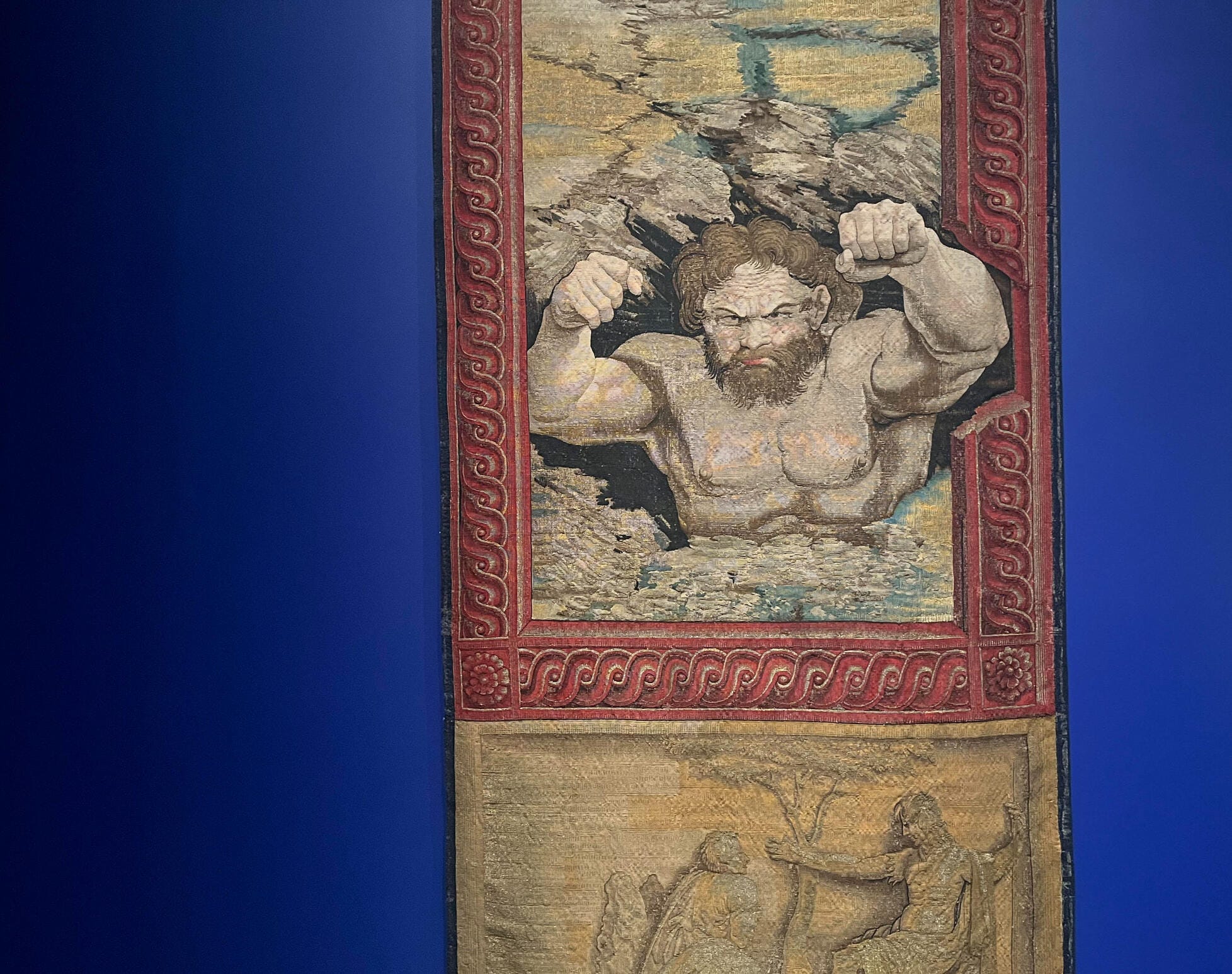
In the last room, I don’t look at the art. I watch everyone move around, inspect, try. One guy keeps snorting, another holds a paper grocery bag with surprised awe. The only piece I stop at is on the wall beside the exit; it would’ve gone unnoticed had my friend not pointed it out. In a large vertical tapestry, muscle man smashes toward the viewer, a stone chunk taken from the red twirls which surround him. The comment from one couple is “It’s like a comic book.” Correct. How and why Raphael ended up doing tapestries with graphic novel gimmicks is unclear. Maybe wall text explains it, but I don’t want to read it. Instead, I listen to the man with big black boots explain to an elderly couple how “Even though it’s paint, it’s like poetry, you know, with the frame and the gold,” picture, “I’ve been drawing for fifty years and all I get is pain but at least I can come here and feel it’s okay because they were just a bunch of religious nutballs and maybe nuclear war won’t happen,” picture, picture, “maybe it’s going to be alright,” picture, “so, what do you two do?”
It’s colder than when we came in. Spring can be deceptive. My group gathers for a cigarette. Our conversation is about the limits of human knowledge.
Raphael: Sublime Poetry, The Metropolitan Museum of Art, March 29 - June 28, 2026
About the Author:
Brock Riggins has written for The Manhattan Art Journal, Ink & Image, Medici Museum of Art, and Micki Meng. He lives in New York and has just finished Autumn Semester, a novel he hopes to be his debut.