

Reflections from a Dead End
Flora Yukhnovich’s Four Seasons at The Frick
February 19, 2026 | by Eric Bayless-Hall
“How much finer things are in composition than alone. ’Tis wise in man to make cabinets.” – Emerson’s Journal, July 13, 1833.
A cabinet is queer sort of thing, no?—a dead end in which we place and leave and later find things, whose grouping can appear at once accidental and, in flashes, overwhelmingly necessary. The making of cabinets I first took Emerson to be referring to is not that noble craft of woodwork but rather the arrangement of things within one—the making of as it were a mere cabinet into a cabinet, say, of curiosities, or of natural history, as the Cabinet of Natural History in Paris which occasioned the above quoted note, where he had seen gathered together so many organic and inorganic forms. His entry continues:
Here we are impressed with the inexhaustible riches of nature. The universe is a more amazing puzzle than ever as you glance along this bewildering series of animated forms,—the hazy butterflies, the carved shells, the birds, beasts, fishes, insects, snakes, and the upheaving principle of life everywhere incipient in the very rock aping organized form. Not a form so grotesque, so savage, nor so beautiful but is an expression of some property inherent in man the observer,—an occult relation between the very scorpions and man. I feel the centipede in me,—cayman, carp, eagle, and fox. I am moved by strange sympathies; I say continually “I will be a naturalist.”
The experience reported, I want to insist, is the discovery of the observer’s relation to his environment—to the things we call living and nonliving that one shares the world with—and that this discovery coincides with, or simply is, the discovery of order where mere amalgam seemed to be, an order—organization, formation, composition—which, importantly, includes the observer.—Not, in other words, an order we somehow impose onto variety, but an organization which composes us, our organism, and into which we will decompose.
That this discovery takes place in a cabinet is worth dwelling on—that this encounter with (let’s call it) nature (one’s own and one’s environment’s) was arranged by human hands. This, I think, helps us to understand why “’tis wise in man to make cabinets.” We are wont, I think, to think of nature as expansive and ever-open, infinite and inexhaustible, something we might enter and be swallowed by—or else plunder and be rewarded by. But this is a strange picture if we, indeed, are animals and so are, quite literally, never—really—apart from nature. We forget that our view of it is always a view within it. But this means we, at least—we humans—are required to meet the world within human limits too, for these are animal limits. (And the denial of those limits coincides with the denial of it as our environment, what we turn within.) We can meet it, no doubt, outdoors, but not, as it were, outmind. Experience is sometimes pictured as a play on a stage of the mind;—here we can picture experience as the shifting contents of a cabinet: everything encountered coming in and going out of the room we inhabit. But then this is metaphorical, and Emerson seems literal: ’tis wise in man to make cabinets—as though we aren’t given enough in our experience, or don’t see enough of what’s given. And here I think we can hear him to say not merely ’tis wise to arrange things within a cabinet, but ’tis wise to make the cabinet itself: that making a space is a first step toward making an arrangement, and is the step that acknowledges our limits, which, rather than closing us in, reveals the obverse angles of nature’s surrounding presence. We might hear this as something of a naturalist’s justification, or rediscovery, of the indoors.
And there are lines to follow out here on how and where nature and art touch.
But I bring this all up in light of a cabinet no one wants to be in.
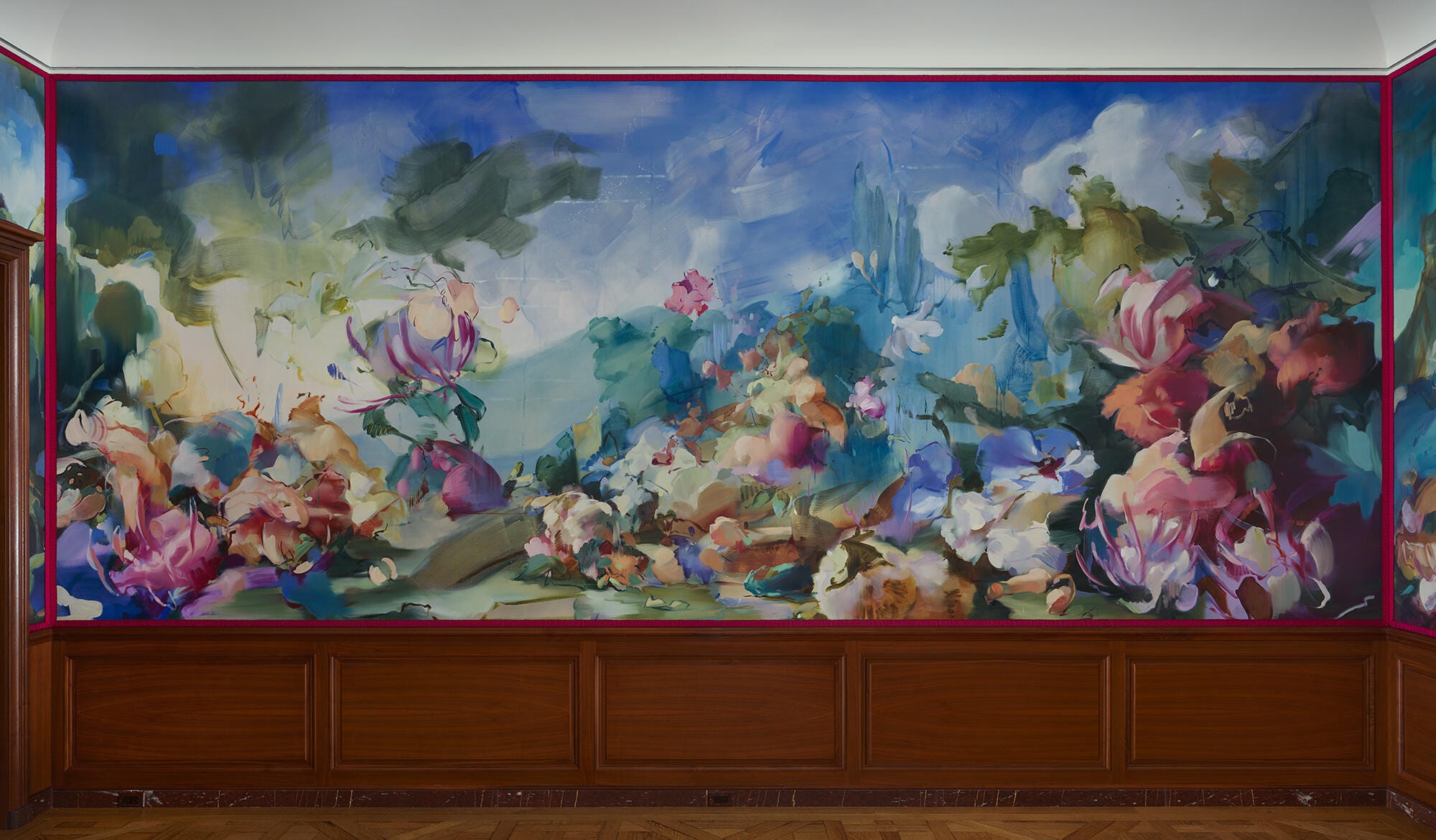
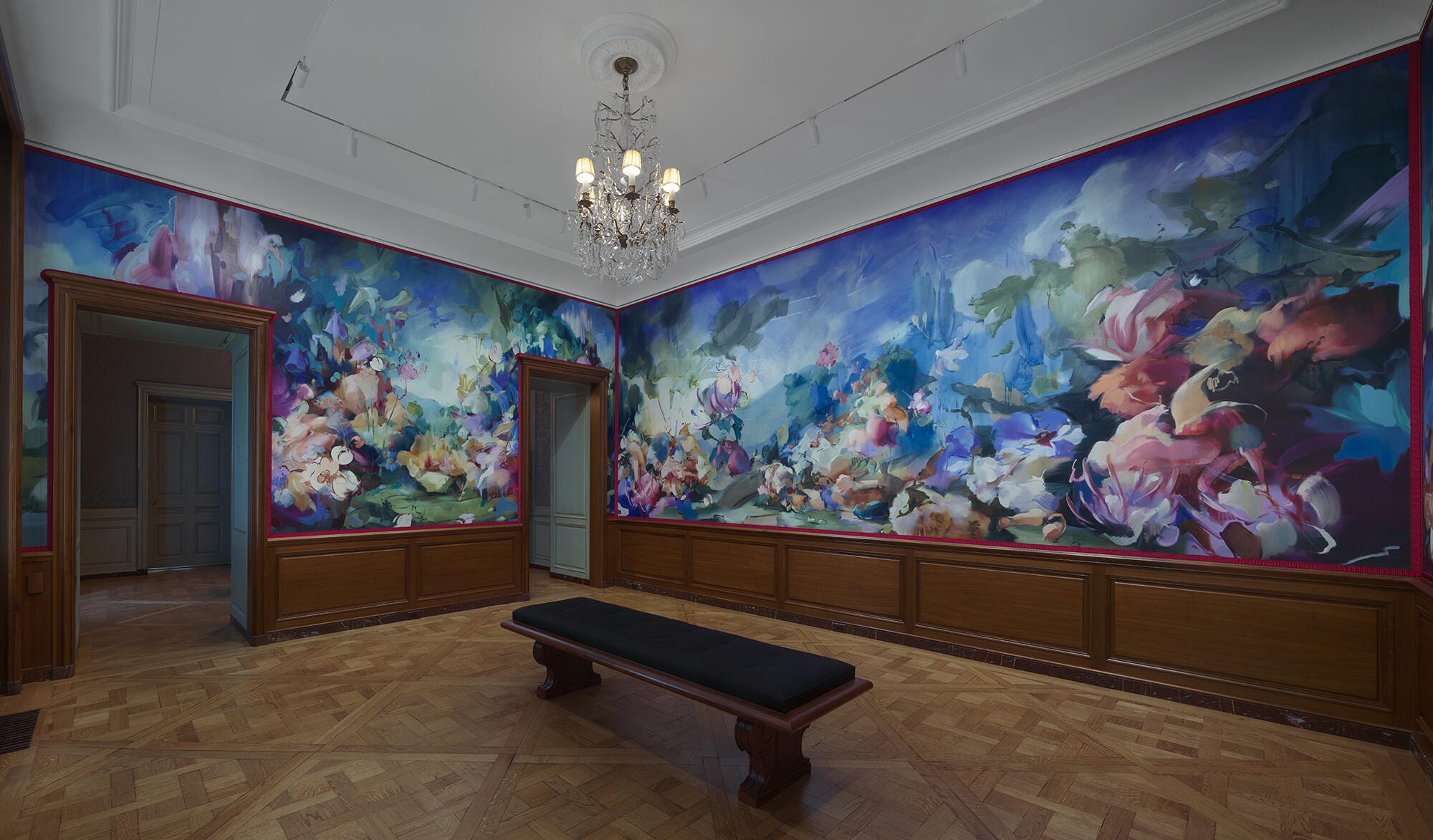
Flora Yukhnovich’s Four Seasons fills four sides of The Frick’s Cabinet, formerly home to Boucher’s The Arts and Sciences. If you came into this cabinet, did a lap, and left—as all do, since no photographs are allowed and there’s no other way out—you might talk yourself into thinking there is meaning there. But, of course, you left, and don’t care to go back and find out.
I think we are liable to confuse ourselves about what meaning is and isn’t, and so insist on it where it isn’t and deny it where it is. Part of this is no doubt owed to a genuine mystery. But I say baldly, but not blithely, that a work is meaningful which we want to keep attending to, turning and returning to. And this wanting is not a matter of words alone—of saying you want to—but of caring to and, opportunities availing, continuing to. The great works of art—the works that compose our personal canons (personal cabinets), that act as touchstones for the great—are those we are never done seeing or reading or hearing (etc.). (I take this to be definitional of a great work of art, not an accident to one.) So the promises that Four Seasons makes are promises to continue rewarding attention. Instead, however, and I say this without denying the pleasantness of its painterly moments, we find abundance covering over a deeper lack. Many forms will certainly take longer to see than fewer, but that doesn’t change the fact of their finitude, that once you see every inch of the canvas, you’ve seen all there is to see.
But I’ve almost neglected to discuss the work. What’s promising in it? And what fails?
On each wall is a landscape scene a la ’30s Disney™ backgrounds overlaid with an abundance of forms, some recognizable as flowers, fruits, trees, birds, beasts, and others suggestive of forms we aren’t quite able to identify—most, nevertheless, with a couple curious exceptions, suggestive of the organic: roundnesses, drips, pools, scratchy patches—suggestive, though we’re not always sure what of. Some of what is painted takes time to see. Amid so much information, discovering the few humanesque forms is not immediate. And, though I do not feel the centipede in me, this is promising. Why? Because there’s more than one thought was there—more to look at—and first impressions, though hard to shake, too often tell us more about ourselves than about the work. So we attend.
The second promising step this work invites is to have us look at the paint. Yukhnovich is evidently skilled with the medium. A surprising variety of technique goes into the making of these forms and always in a way revealing of the strokes. This is presumably what is meant when the work is described as being “contemporary abstraction” (a phrase we’ll want to come back to): standing an arm’s distance from almost any stretch of canvas we find strokes growing out of one another, suggestive of organism, sometimes becoming full fledged flowers or deer.
But where does this lead? What does it promise? First, that there is something to see. And that something, if this is to be more than a game of I Spy™, is not just anything, but something worth seeing. (The work is taken on trust when its worthiness isn’t immediate. Many of the best aren’t; so this is all promising, as far as it goes.) But though the painter has an eye and hand for the pleasing paint mark, this doesn’t reward looking any more (in fact, less) than the Snow White backgrounds they resemble (and even less than the Bouchers they vaguely ape).
The most promising thought is that the outgrowth and interplay of forms in Four Seasons might become an image of the organic itself—that the abundance might not be abundance merely, that the discovery of forms in the thicket of shapes might be more than a game of recognition in a crowd, that the painter’s interest in paint’s suggestiveness might come to more than the sense—which by itself is not confirmed to be more than the hallucination—of meaning. You see, if all this painting has to offer is its abundance of stuff to look at, and that looking doesn’t coincide with any deepening or broadening of one’s sense of it, then we are to conclude that it is just a dead end to enter once. And at that point it is just a pretty wallpaper or background, to be grouped with the Edge observation deck, not the Frick’s masterpieces. At that point—though I never thought I’d say it—why not let people take pictures?
But one’s disappointment is relevant to criticism only to the extent that it is explained by the work. So what is responsible for what I called this work’s deeper lack?
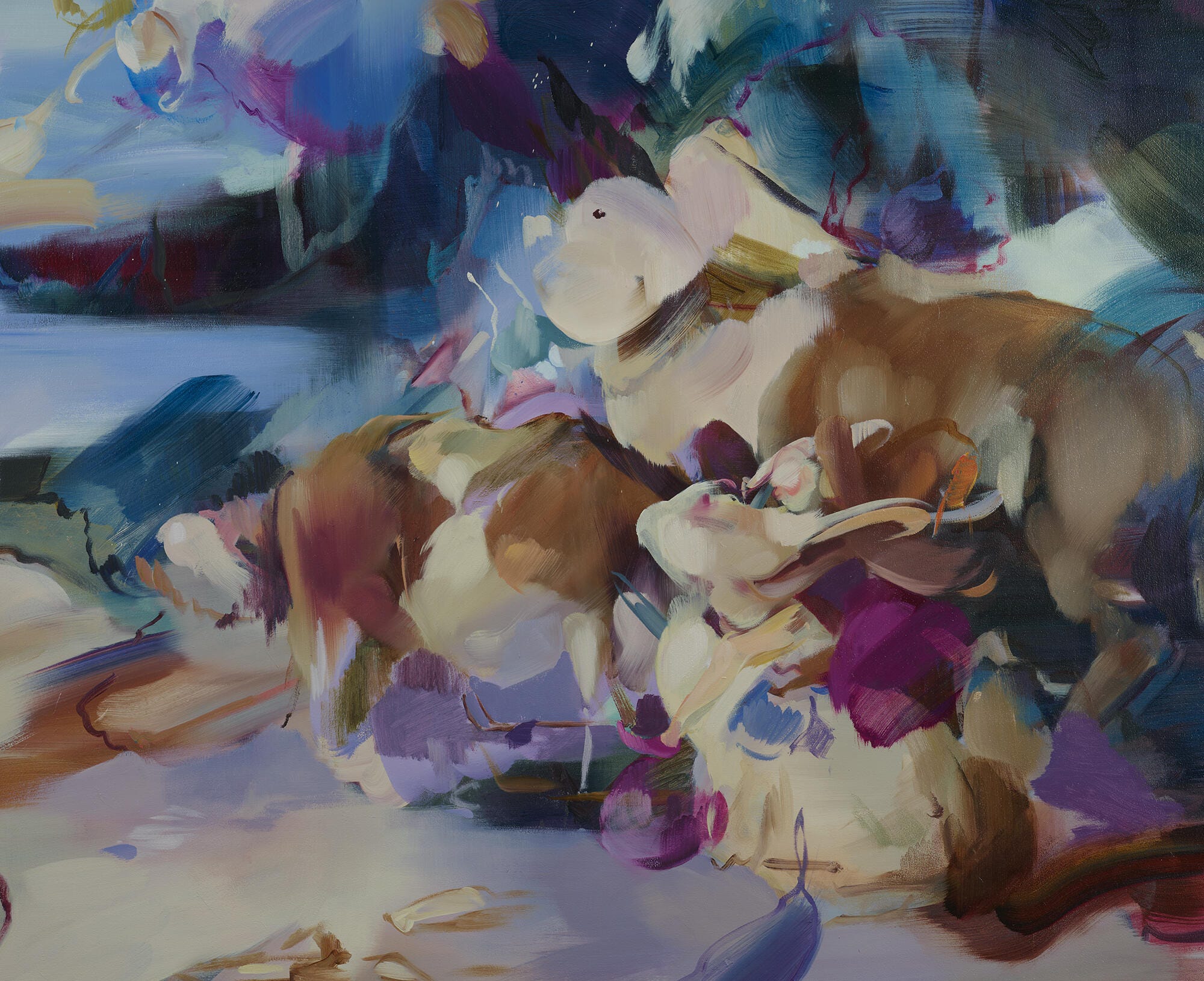
I find a clue in the painting’s human forms—humanoid is more appropriate, since they are rough and more of the Barbie™ than the animal kingdom—painted in ways similar to other figures, but consistently more sketchily and incompletely than other organic objects. At first this suggested the (promising) idea of humans as no larger part of this environment than peaches and pansies, which I hoped would lead to a thought of what an environment according to this painting is—and, seeing as it depicts (kind of) the four seasons and actually encloses you, this promised to bring several strands of observation together. (Hence I was led back to Emerson, and wished to stay there.) But this thought hits a dead end in the fact that these humans are fantastical: almost elvish creatures astride bunnies and moose-like beasts more at home in Narnia than Central Park. What promised—to my ears—to be a picture of the natural world that we are outgrowths of, proves on closer inspection to be heedless of reality.
Parodying Johnson, the late William Aile said that it is easy to achieve the pleasurable once you have abandoned the real. We might add: and if the pleasurable starts to seem like a high bar, the fantastical is even easier. And lest I insult those who aim to express—as our time is in need of expressing—the fucky fact of fantasy in modern life, let me clarify the scope of my criticism. Four Seasons, if it has wished to reflect on fantastical forms as part of our environment, fails to begin to do so, for these elements are only inchoate. And if I’m right that what this painting wishes to express are possibilities of reality and the human organism in relation to its environment, then it fails to get there, and the swerve to the fantastical is a dodge. In an age characterized by the avoidance of reality, this seems like the better referent for the painting’s Contemporary Abstraction™, which starts to sound less like the press release noise it first seemed and more like a condemnation.
Others might find more and better to criticize in Four Seasons, but it would require remaining longer in the room, which I venture to guess they won’t do.
About the Author:
Eric Bayless-Hall teaches and studies in New York. His writing appears in The Revenant Quarterly.